
Dominica: open a bank account for non-residents
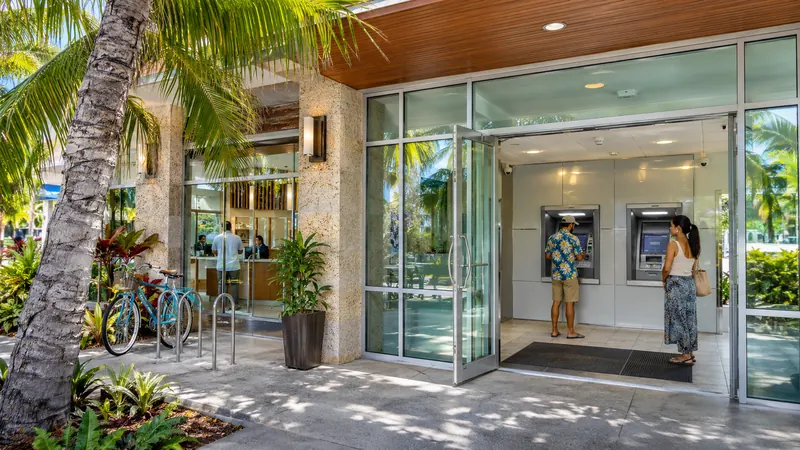
Dominica: a bank account for non-residents can be opened with a handful of commercial banks based in Roseau, on an island whose currency is the Eastern Caribbean dollar (XCD), pegged to the US dollar. Each bank sets its own conditions, usually a passport, proof of a foreign address, banking references and an explanation of where the money comes from. Property buyers, citizenship-by-investment applicants, medical students and yacht owners make up most foreign applicants. The file should be prepared well ahead, because processing times vary widely from one branch to another.
A small island with a short list of banks
Dominica, not to be mistaken for the Dominican Republic, is an English-speaking Commonwealth nation lying between Guadeloupe and Martinique. Roseau, the capital, holds nearly all branches. Retail banking is concentrated in a locally rooted national bank, a few subsidiaries of regional groups and a network of credit unions that serve villages across the island.
That narrow field matters in practice. A bank that declines an application often has no direct rival nearby, and credit decisions may depend on a regional head office located on another island. Submitting a complete package at the first contact is wiser than approaching several banks in a row, since institutions on a small island tend to hear about difficult profiles quickly.
Nature tourism, hikes around Morne Trois Pitons, hot springs and diving shape the economy, with income arriving largely in foreign currency. That stream of visitors, investors and foreign owners explains why local banks are interested in non-resident customers while subjecting them to strict monitoring.
Currency and central bank: the Eastern Caribbean dollar
Dominica belongs to the Eastern Caribbean Currency Union. The shared currency is issued by the Eastern Caribbean Central Bank, headquartered in Basseterre, Saint Kitts and Nevis. The rate has been fixed for decades at 2.70 XCD to one US dollar, which makes transfers from the United States easy to price.
For a non-resident the effect cuts both ways. US dollar accounts are often offered next to XCD ones, saving a conversion on each payment. Transfers from Europe, however, usually travel through a US correspondent bank, adding fees and several working days. Ask for the exact SWIFT details and the name of the intermediary bank before sending the first deposit.
A stable peg does not remove every risk. An account held in XCD by someone living in the euro area is still exposed to swings between the euro and the US dollar, since the XCD follows the latter. An owner paying bills from Europe is better off grouping transfers than multiplying them, because each operation carries fixed fees.
US dollar and XCD accounts
One customer can sometimes hold both currencies. The XCD account handles local spending, such as electricity, water or a caretaker's wages, while the US dollar account receives transfers from abroad. State the currency of each operation at the outset to avoid conversions at an unfavourable rate, and ask whether the bank shows its exchange rate on a separate line of the statement.
Who needs a bank account for non-residents in Dominica
The commonest applicant is a buyer of land or a villa who must pay property tax, electricity, insurance and upkeep from a local account. Next come investors in the citizenship-by-investment programme, run by a government unit, whose contribution is normally paid through official channels rather than through a personal account opened on the spot.
Others include students at the island's medical schools, sailors wintering in the marinas, eco-lodge owners and remote workers drawn by the island's nature-island image. Each profile calls for different evidence: a property owner shows a deed of sale, a student an enrolment letter, a boat owner proof of registration for the vessel.
Foreign companies that run a guesthouse or a dive operation may also look for a business account. That requires company registration papers, a list of directors and articles of association, with a longer review than for an individual. The bank weighs the activity, the intended clientele and the expected flows before accepting the file.
Documents required for a bank account for non-residents
A Dominican bank typically asks for a valid passport, a second form of identification, proof of a recent foreign address such as a utility bill or statement under three months old, and a completed application form in English. Many also request one or two reference letters, at least one of them from a bank, and a short description of the applicant's occupation.
Source of funds receives the closest attention: an employment contract, payslips, tax assessments, a property sale agreement or the statements of the account that will fund the first deposit. Documents written in other languages may need a certified translation, and copies are often required to be certified by a notary or an embassy.
The opening deposit
Minimum amounts depend on the bank and account type. Some institutions ask for a few hundred dollars at opening, while others raise the threshold for non-residents. Funds arrive by wire, rarely by foreign cheque, which local banks clear slowly.
Banks active in Roseau and beyond
The National Bank of Dominica remains the best-rooted institution. Scotiabank and CIBC Caribbean, subsidiaries of Canadian groups, bring card and wire infrastructure closer to international standards. The Dominica Agricultural, Industrial and Development Bank lends mainly to farming and small enterprise and does not target foreign individuals.
Credit unions are numerous but cater first to residents and members of their community, so they are rarely a realistic route for a non-resident without a personal tie to the island. Licensed citizenship-by-investment agents sometimes steer clients to one of the three commercial banks, which already know that kind of file.
Cards and cash withdrawals
Cash machines are found mainly in Roseau, Portsmouth and a few coastal towns. Outside those areas, cash payments remain common, including at guesthouses, tour guides and small shops. An international debit card is useful, but its daily withdrawal limit, often modest, is worth raising before a stay.
Opening a bank account for non-residents remotely: what is realistic
Some banks will start by email and accept scanned documents, but opening a full bank account for non-residents without any visit remains uncommon. Forms often have to be signed in front of an authorised person, or through a local lawyer or agent who confirms your identity in person.
If a trip to Roseau is planned, announce it in writing and fix an appointment several weeks before arrival. Flight connections to the island run through neighbouring hubs, and branch hours tend to shrink at the end of the week, so there may be no second chance during a short stay. The island keeps UTC-4 all year, with no daylight saving.
Compliance, FATCA and information exchange
Dominica follows the anti-money-laundering standards monitored by the Caribbean Financial Action Task Force. Banks identify the beneficial owner behind each account and watch incoming wires. They also report foreign tax residents under the Common Reporting Standard and, for US persons, under FATCA.
In practice the account holder supplies a taxpayer identification number and a country of tax residence at opening. A US citizen or a person taxable in the United Kingdom or France may face extra questions. Holding an account abroad is not unlawful, but it generally has to be declared in the home country under that country's rules, a point to confirm with a tax adviser.
Declaring the account at home
The holder of a foreign account generally has to report it to the home tax office, sometimes with a penalty for omission. Rules and thresholds differ by country. Keep annual statements, since they serve as evidence in an audit or when documents are requested.
Questions to ask the bank before you commit
Before signing, ask for the full tariff: maintenance fees, charges for falling below a minimum balance, incoming and outgoing wire commissions, and the cost of an international debit card. Check whether a US dollar account is available and whether interest is paid, since many current accounts earn nothing.
Also ask what could lead to closure: long inactivity, expired documents that were never updated, unexplained transactions. Find out whether online banking exists, whether statements can be emailed and how to reach an adviser from abroad. Keep the answers in writing, as they will serve as a reference if a disagreement arises later.
One last point: ask what to do after a change of address, nationality or tax situation. A forgotten update can block an account, whereas a timely one is often settled with a simple form sent by email.
Banks and providers to open this account
- National Bank of Dominica — Roseau-based commercial bank, the most widely present locally, with XCD and US dollar accounts.
- Scotiabank Dominica — Subsidiary of the Canadian Scotiabank group offering current accounts, cards and international transfers on the island.
- CIBC Caribbean — Regional bank of the Canadian CIBC group operating in several Eastern Caribbean islands, Dominica among them.
- Dominica Citizenship by Investment Unit — Government unit giving information on the citizenship-by-investment programme and its licensed agents.