
Saint Lucia: opening a bank account for non-residents
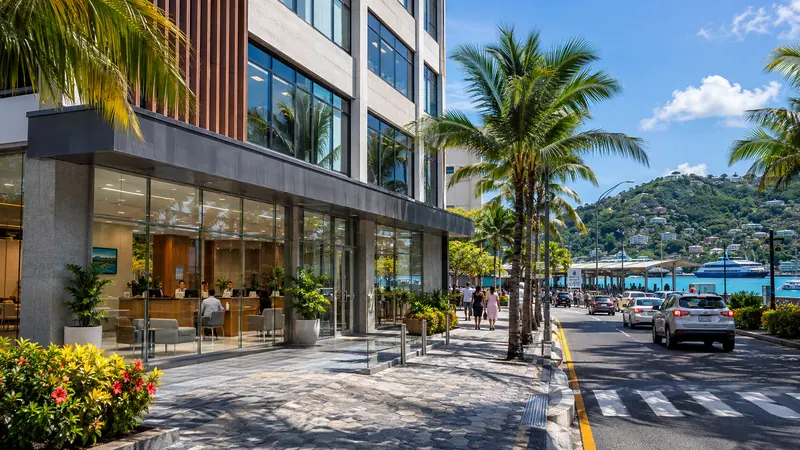
Saint Lucia: a bank account for non-residents is a deposit account opened at a bank on the island by someone who does not live there permanently, in Eastern Caribbean dollars (XCD) or US dollars. Banks ask for a passport, proof of address abroad, bank references and evidence of where the funds come from. Villa owners, investors and holders of citizenship by investment make up much of this clientele. The Eastern Caribbean Central Bank sets the monetary framework, while local authorities supervise banks day to day.
An English-speaking island in the Eastern Caribbean currency union
Saint Lucia, a volcanic island in the Lesser Antilles, has Castries as its capital and Rodney Bay in the north as its main resort area. Independent since 1979, it belongs to the Commonwealth and to the Eastern Caribbean currency union. Its currency, the Eastern Caribbean dollar, is pegged to the US dollar at 2.70 XCD to 1 USD.
The currency is issued by the Eastern Caribbean Central Bank, headquartered in Basseterre on Saint Kitts. It supervises the union’s banks together with national authorities, which gives Saint Lucia a framework close to that of Antigua or Dominica. Local financial services fall under the national regulator.
The island keeps UTC-4 all year. Kwéyòl, a French-based creole, is spoken by much of the population, but English remains the official language of banks and forms.
Who can open a bank account for non-residents in Saint Lucia
Commercial banks quite commonly accept foreigners with a clear plan on the island: buying a villa at Rodney Bay or Soufrière, managing a rental, setting up a company, retiring later. They check that the client’s profile matches the stated purpose of the account.
The citizenship-by-investment programme, launched in 2016, has brought many new passport holders. Banks then request extra papers about the professional background, real tax residence and origin of the investment. A Saint Lucian passport alone does not secure an account.
A client with no tie to the island may be refused or offered an account restricted to business or term savings. Decisions vary from bank to bank, and even from branch to branch.
Applicants who can show recurring links with the island, such as a rental property that generates income or a business with local customers, are generally in a stronger position than those who simply want to hold savings there.

Documents banks request
The standard list begins with a valid passport, proof of address less than three months old and a second piece of identification. It usually includes two references, one from a bank and one professional or personal, as well as the tax number of the country of residence, needed for automatic information exchange.
Evidence of the source of funds is more or less detailed depending on the amount. A property sale, an inheritance, salary or self-employed income is documented by a deed, a tax notice or statements. Banks sometimes ask for a letter from a lawyer or accountant in complex situations.
Documents in French or another language need an English translation. For a company file, the bank adds the articles of association, the register of beneficial owners and directors’ identification.
Retirees and part-time residents
A retiree who spends several months a year on the island adds proof of pension and, where one exists, the residence permit. Banks see this profile as steadier than that of a pure investor. A history of regular transactions from abroad strengthens the file.
Banks in Saint Lucia
Bank of Saint Lucia is the best-known local bank, with branches in Castries, Vieux Fort and Rodney Bay. First National Bank Saint Lucia offers current and savings accounts and services for companies. CIBC FirstCaribbean and First Citizens, a group from Trinidad and Tobago, complete the commercial banking offer.
Credit unions operate under a separate status geared to resident members. They do not always answer requests from non-residents, who therefore turn to the commercial banks.
Providers that assist investors can help prepare the paperwork and book appointments, without guaranteeing the outcome of the application.
Because the banking sector is small, products are broadly similar between institutions. Differences lie mostly in minimum balances, fee schedules, the quality of online banking and the willingness of branch staff to deal with foreign applicants.
Opening a bank account for non-residents remotely or in a branch
Remote steps are limited to sending scans and talking to an officer, followed by the originals. A physical signature in Castries or Rodney Bay is still the rule at many branches, especially for clients without residence.
An in-person visit has several advantages: immediate card delivery, document checks and answers to compliance questions. It is easy to combine with a holiday or a property viewing. Booking ahead is preferable, because branches see few foreign clients without a declared tie.
The wait between the application and the delivery of credentials ranges from a few days to several weeks, depending on how complete the file is.
Booking an appointment before travelling
Contacting the branch by email before departure shows whether an officer is available, which original documents to bring and whether an interview with compliance will be needed. This precaution avoids losing a day of the trip at a branch that does not handle non-resident files that day.
Tax, FATCA and transparency
Saint Lucia applies the Common Reporting Standard and has concluded a FATCA-related agreement with the United States. Banks therefore collect tax residence and may report accounts held by non-residents to the local authority, which passes the information to the state of residence.
The island has developed an international financial services sector, with international business companies and trusts. Transparency rules have tightened in recent years under pressure from international bodies, and banks decline structures without economic substance more often.
Interest earned by a non-resident can be subject to withholding tax under local law. The holder must also report the account in the country of residence, under the rules in force there.
Account currency: XCD or USD
The Eastern Caribbean dollar suits someone paying local expenses. A US dollar account avoids conversions for an owner who collects rent in that currency. The fixed peg protects against exchange risk between the two, but banks apply a margin on every conversion.
Fees and everyday use
Maintenance fees and international transfer commissions are comparable to those at neighbouring banks. A minimum balance may be required, and paper statements are charged. Cheques are still in common use, including for rent.
Local debit cards work in shops and at cash machines on the island and, depending on the network, abroad. Island banks offer online services, but remote access for a non-resident depends on the institution. A mobile app may require a local phone number.
Dormant accounts can be closed. A small regular movement avoids that risk. Foreign cheques can take weeks to clear, so wire transfers are the faster route for larger sums.
Checks to make before opening an account
Ask the bank in writing whether it accepts non-residents with the applicant’s profile, what opening deposit it requires and which documents must be certified or translated. The answer should also state the processing time.
Look into maintenance fees, incoming and outgoing transfers, withdrawal limits, whether online banking works from abroad and how dormant accounts are handled.
Finally, learn about reporting duties in the country of residence and keep all papers linked to the opening. A tax adviser can explain how to document the source of funds.
Banks and providers to open this account
- Bank of Saint Lucia — Leading local bank with branches in Castries, Rodney Bay and Vieux Fort.
- First National Bank Saint Lucia — Bank offering current, savings and company accounts.
- CIBC FirstCaribbean — Regional subsidiary of the Canadian CIBC group, present across the Caribbean.
- First Citizens Bank — Banking group from Trinidad and Tobago active in several Eastern Caribbean islands.