
Solomon Islands: open a bank account for non-residents
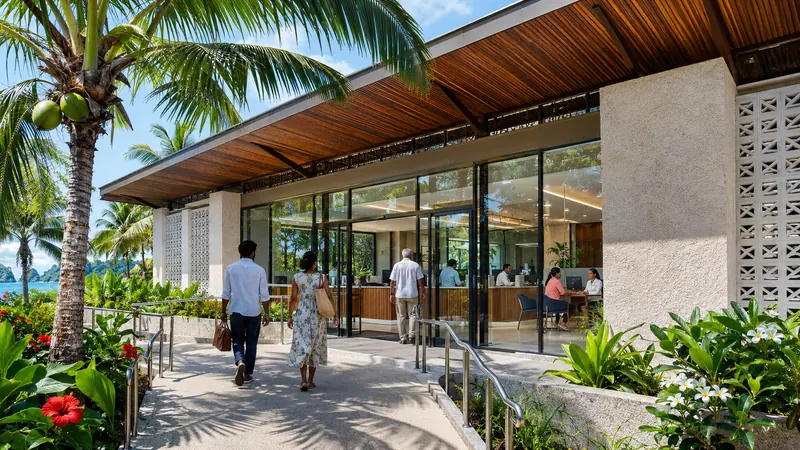
Solomon Islands: a bank account for non-residents is available only through a handful of banks centred on Honiara, in a country where foreign exchange is closely supervised by the Central Bank of Solomon Islands. ANZ, BSP, BRED Bank Solomon and Pan Oceanic Bank each set their own rules. Applicants generally supply a passport, proof of address, a statement on the source of funds and the purpose of the account. Branch visits remain common, foreign currency accounts need approval, and no bank guarantees to accept an applicant who lives abroad.
Banking in an archipelago of nearly a thousand islands
Solomon Islands stretches across almost a thousand islands in Melanesia, east of Papua New Guinea. About seven hundred thousand people live in a landscape of forests, reefs and volcanic ridges, and most reside in villages rather than towns. Honiara, on Guadalcanal, is the capital and holds the head offices of banks, ministries and the main port.
The Central Bank of Solomon Islands licenses banks, supervises the financial system and operates the exchange control framework. The currency is the Solomon Islands dollar, which circulates alongside no other everyday currency. Foreign money such as Australian, New Zealand or United States dollars must be exchanged at banks or authorised bureaus before it can be spent in shops.
Honiara grew rapidly after independence in 1978, and it continues to attract families from the provinces seeking jobs and services. The city handles most imports, government salaries and mining and forestry payments, which explains why almost every large bank transaction in the country ends up passing through its branches.
Logging, fisheries, palm oil and gold are the main sources of export income, and the country has seen periods of political tension, including riots in Honiara in 2021. Such events remind banks and customers of the importance of secure premises, back-up systems and clear procedures for continuity of service.
The banks and who they serve
Four names appear in most guides: ANZ, Bank of South Pacific, BRED Bank Solomon and Pan Oceanic Bank. ANZ and BSP have the largest networks, with branches and ATMs beyond Honiara, while the other two are smaller and more focused on specific segments.
Customers who live abroad should not assume that online enquiries lead to quick approval. Policies change with the compliance teams of the banks’ parent groups, and local managers may need to escalate each file.
ANZ and BSP
ANZ publishes terms for savings and transaction accounts and an investor guide for businesses. BSP offers personal and corporate accounts and a network that stretches to provincial centres. For foreigners they often request a passport copy, an employer letter or recent payslip and a utility bill.
BRED Bank Solomon and Pan Oceanic Bank
BRED Bank Solomon belongs to a French banking group and serves individuals and companies. Pan Oceanic Bank requires applicants to state the purpose of the account and the main source of funds. Either bank may suit a customer with a clear commercial reason for dealing in the Solomon Islands.
When a local reference helps
Banks in small countries often rely on personal knowledge. An employer, a lawyer or a business partner in Honiara who confirms the applicant’s identity and purpose can speed up approval. Without such a link, the bank may ask for extra information, additional references or a visit before it will open the file.

Documents for a bank account for non-residents
The central item is a valid passport. Banks also record full name, date and place of birth, nationality, occupation and a signature specimen. For a person living overseas, proof of address comes from the country of residence and should be recent, usually less than three months old. A tax identification number from that country is often requested as well.
Additional papers depend on the profile. Employees and consultants show a contract or employer letter, and landowners, logging or fishing investors and traders add licences or agreements. Companies present registration documents, a board resolution and details of signatories and beneficial owners. A source bank attestation or transfer proof may be asked for the initial deposit.
Certified copies are widely used, and some banks require originals during a visit. Because the minimum opening deposit is small, the real hurdle is compliance, so a complete, consistent file matters more than the amount.
Some applicants are asked to provide a short written statement describing their plans in the Solomon Islands: employment, investment, family support or research. The statement should agree with the documents supplied and give expected deposits in Solomon Islands dollars or Australian dollars, avoiding vague descriptions that cannot be checked.
Exchange controls and international payments
The Central Bank’s exchange control policy requires approval or reporting for many foreign currency transactions. Opening a foreign currency account in the country needs authorisation, and large transfers abroad can require documentation. Dealing in Solomon Islands dollars is simpler for most newcomers.
Incoming payments typically arrive through Australian correspondent banks. The sender should supply the beneficiary’s exact name, account number, SWIFT code and a short reason for payment. Intermediary fees can reduce the amount received, and the bank may hold funds if compliance questions arise, especially for the first deposits.
Mobile money services run by telecom operators and banks help families move small amounts to provinces without branches. They do not replace a bank account for large or regular transfers, but they are a useful complement for remittances and salary payments, and they show how banking in the country is adapting to geography.
Day-to-day banking
Honiara offers branches, ATMs and card terminals in hotels and supermarkets, but cash remains common elsewhere. In remote provinces, banking can mean travelling by boat or small aircraft, and mobile money is an important complement. Internet banking exists with ANZ and BSP, with limits on transaction size.
The time zone is UTC+11. English is the official language, and Pijin is the everyday lingua franca. Customers abroad should check how statements and security codes are delivered and whether the bank can verify signatures electronically.
Remote provinces still face limited electricity, patchy internet and expensive transport. Customers who travel outside Honiara carry cash in advance, as card terminals are scarce. Anyone planning to manage the account from abroad should ask which services can be reached without internet and how long a lost card takes to replace.
Compliance and tax reporting
Banks follow international anti-money-laundering standards and scrutinise the origin of funds, especially in sectors such as timber and mining. Non-resident customers may face additional questions, and a bank may decline an application without detailed reasons.
Holding an account does not remove tax obligations in the country of residence. Many tax authorities require foreign accounts to be declared, and cross-border information exchange continues to expand in the Pacific. A tax adviser in the home country can explain the rules for a given situation.
Sectors such as timber, mining and large land deals receive extra attention from banks and from authorities. A customer linked to these areas should keep licences, concession agreements and tax documents ready, since compliance staff may ask for them before accepting deposits or approving transfers.
Questions to ask before opening a bank account for non-residents
Ask whether the bank accepts customers who do not live in the country, which accounts are open to them and whether a visit to Honiara is required. Request a written list of documents and certification rules, plus the minimum deposit, monthly fees, wire charges and card limits.
Also ask which correspondent bank handles foreign payments, how long cheques are held, what happens to dormant accounts and whether foreign currency accounts are available to non-residents. Comparing ANZ with BSP, and a smaller bank, gives a realistic picture of timing and service.
Banks and providers to open this account
- ANZ Solomon Islands — Australian bank with branches in Honiara and provincial centres, offering savings, transaction and business accounts.
- BSP Solomon Islands — Pacific banking group with a wide network in the Solomon Islands for individuals and companies.
- BRED Bank Solomon — Subsidiary of the French BRED group, providing retail and corporate banking in Honiara.
- Pan Oceanic Bank — Local bank in Honiara offering deposit accounts and services for businesses.